Showing posts with label Daily 5. Show all posts

Daily 5 Second Edition- Chapter 2

http://thatfirstgradeblog.blogspot.com/2014/03/the-daily-5-second-edition-book-club_24.html

Jen over at That First Grade Blog wrote up a great summary of Chapter 2 of the second edition of Daily 5. Chapter 2 goes into details about the core beliefs. These beliefs are trust and respect, community, choice, accountability, brain research, transitions as brain and body breaks, and 10 steps to Independence. The last core belief, 10 steps to independence, is given a whole chapter- Chapter 3. Instead of repeating what Jen wrote up, and saving me some time, I decided to just focus on community, choice, and transitions as brain and body breaks. Click the above icon to visit Jen and read more about the core beliefs of Daily 5.

At the beginning of the year, I focus on building community to get my little kinders to become a "family". I use morning and afternoon meetings. My morning meetings follow a combination of Dr. Becky Bailey's Conscious Discipline and Roxanne Kriete's Morning Meeting. After our morning routine and Read to Self time, we start our day with a morning meeting.
  •  First, my kinders stand in a large circle at our meeting area. 
  • Next, I play a community building song that has my kinders doing actions together. Some of students' favorite songs are by Dr. Jean (Hello Friend or Ride That Pony). 
  • Then, we sit in a large circle and pass a morning greeting around. 
  • Last, we discuss our goal for the day to help our classroom become a better place. 
  • After that, we move on to our morning message and word work goal. 
In the afternoon, I have my students group together for the last part of the day. This is a time to focus on the positives of our day. We share what we are proud of or how someone filled our bucket. This way my students can go home and hopefully share some of their successes of the day. Success mapping is a way to help build optimistic attitudes. According to brain research, optimism can be taught, and students who have optimistic attitudes are more likely to be better problem solvers than those with pessimistic attitudes. We end our day with a fun brain break song (usually a Just Dance Kids video on youtube).

In addition to my classroom meetings, I use Kagan cooperative learning strategies to build classroom community. Sometimes, we have a meeting during the day to discuss any problems and ways to solve them.

Choice is such a deterrent to behavioral problems. I remember sitting in one of my early childhood classes, and Dr. Becky Bailey was telling us that giving children choices would help with those who wanted power. I applied this technique one night watching my nephew. This three year old cutie did not want to go to bed. Instead of arguing, I told him he was going to go to bed, but he had a choice in how he went: piggyback ride or horseback ride. He choose piggyback (tired me out with him on my back). He went to bed without any issues. The next night, he looked forward to trying the horseback ride to bed. In class, I have had children who do not want to draw or write. So I gave them choices depending on their needs. Sometimes it is the writing materials (markers or crayons) or place (carpet or small table). I apply this to the Daily 5, in a way that works for me and my kindergarteners. My students choose their books to read during Daily 5. They choose from one of the 3-4 word work choices at their assigned area.

Transitions seem to go smoothly as I use music to signal clean up time. I use my ipod with pre-made categories to help with transitions. Dr. Jean has some clean up songs that my students sing along as they put away materials. After word work, I like to use my whiteboard and overhead to display HeidiSongs singing and moving to a sight word song. My students know that they must clean up before joining, so they get right on task and join as soon as they can. They love to sing and dance!

Check out my previous D5 posts for some freebies. Have a great week!


2

Daily 5 New Edition Book Club- Chapter 1

I am joining in on Jen's, from That First Grade Blog, book club. The new edition of Daily 5 is the book of choice. I have bought it a few weeks ago, and have not started reading it yet. It has been a bit busy around here... hence my not posting. It is my last day of spring break, and I did want to post something... so here I am. :0) (Okay, I have now read it!)

http://thatfirstgradeblog.blogspot.com/2014/03/the-daily-5-second-edition-book-club.html

What should you know about me?
I have implemented Daily 5 in my kindergarten classroom for the past 6 years. I am not a true Daily 5 follower, as I have made modifications each year to meet my classroom needs. Each year, I do something different depending on what is going on. Currently, this year has been a challenge since my district has mandated Reading Street as its series to follow during our literacy block.

How did I hear about Daily 5?
I first heard about Daily 5 when I moved down from teaching first grade to kindergarten (about 7 years ago). My good friend, Krissy, and first grade team leader, got the whole entire first grade team on board to follow Daily 5. She wrote a grant for all first grade classrooms at our school to have ipods as a listening center. She certainly peeked my interest, and I borrowed her book (the first edition) and couldn't put it down. It was easy reading. I had my hesitations about it, but was able to see how first grade embraced and loved it.

What experiences have I had implementing Daily 5?
When I first started Daily 5, I called it Daily 3. I focused on Read to Self, Listening to Reading, and Word Work. My kinders had choices of which one they wanted to go to. Now, I implement all components, though not on a daily basis. Read to Self, Word Work, and Writing Workshop are my main components. Sometimes, we get to Read to Someone and Listen to Reading. This is the first year that I have focused less on Listen to Reading and more on Partner Reading (Read to Someone). My students still have choice, but we are all doing the same activity at the same time. Over two years ago, I went to Kim Adsit's "Differentiated Instruction for the Little Guy" and learned how she organized her groups of students. I have 4 areas named after some owls I have made and hung in my classroom. Each area has a space that has materials for all components of Daily 5 and my Math Stations. Each group of students rotate through the different areas visiting one per day, making choices in that area. I have done it this way for two years, and it has worked for my classes.

Does what my class do, during literacy block, resemble the before or after description of the sisters' classrooms?
My class resembles the "after" description of the sisters' classrooms. However, it is still a work in progress. I still have to give student reminders or go over routines. I am looking forward to see if there are some tips in helping me teach my students how to self monitor themselves more. A couple of weeks ago, 2 kindergarten teachers from another school came to visit my class to see how I implemented Daily 5 with Reading Street. They were full of positivity, and my kinders made them feel welcomed. One comment made from one of the teachers was where were my misbehaving students. I have them, but they take their reading seriously and enjoy learning through the Daily 5 structure. My kinders also love to show others how they do things in their classroom.

What is one thing I read in Chapter 1 that I think is worth remembering?
"...Daily 5 is not a prescriptive program to be followed blindly, the same way each day, week, month, and year. Instead, we as educators need to respond and react to the diverse needs of our own students." I remember when Daily 5 first came out, and I did not follow it to the T. I was criticized and told I was not following Daily 5. Okay, I was not, but I used elements from it to make it work for me and my class. This really hits home this year as my district mandated that we had to follow Reading Street with fidelity the first 12 weeks of school. I implemented Daily 5, but with resources I already had. Reading Street did not give me tools to do this. I also use cooperative learning structures for group activities, and Reading Street does not encourage this. At least, not in the teacher manual of daily teacher talk. I know this from trying to follow it, but also knowing that one resource is not the best. I am one who uses different resources to teach my students.

What is one change I am ready to make in my classroom?
As I read and find more about Daily 5, I will modify and adjust to my students. I am still working on making my math structure better in my classroom. It used to work well, then I had to use the GoMath series. For the past three years, I keep adjusting and modifying my math structure to include the GoMath series in a way that helps my students. Looking forward to getting more ideas from others about how they are able to combine using a series with Daily 3 for math.

2 summers ago, I joined another book club about Daily 5. Just go to my side bar and click on Daily 5 to find links to those previous posts and other resources. Thanks Jen for giving me that incentive to start reading my new book!


3

Stretchy Snake

What do you do during CAFE's mini lessons? The last two weeks, I focused on Stretchy Snake with my kinderkids. There are so many cute freebies on TPT about Reading Strategy buddies. However, I am using what I had found originally before I discovered TPT. I still use Christina Bainbridge's mini posters (free) and now I have included Deanna Jump's Guided Reading activities ($) to help with introducing and practicing reading strategies using little stuffed animals. I only introduce one at a time. So far, we have Eagle Eyes, Lips the Fish, Stretch Snake, and Chunky Monkey. I post my CAFE menu on my cabinets.
 
I created my own strategy cards. April Larremore has a great freebie that inspired me to make my own

I found the colorful CAFE headers on TPT for free from Rachelle Rosenblit.
 
 
Two weeks ago, with our Reading Street series big book, Flowers, I took out some bean cards made from Growing Kinder's Math & Literacy for Little Sprouts. I dispersed the 12 green bean cards around the room and had my students work in pairs. They folded their papers into quarters to make 4 boxes. They worked together to use "Stretchy Snake" to sound out CVC words. Then they numbered the box to match the bean's number, wrote the word, and drew a picture. They looked like they were having a good time, and they did such a great job working together!


While they were working, some of my kinders finished quickly, so I had them do 4 more on the back. I thought to myself about doing this activity again, but differentiating it for my students. So this past week I created another version using fall leaves. Some of my kinders needed more challenging words, so I moved to using some blends and sh- words. Many need practice with CVC words, so I had those out as well. We colored a yellow or red dot on top of our papers to help us remember which words we were going to try and read during this mini-lesson.


 I made a fall packet of words that can be used for kindergarten or first graders. There are short vowels, long vowels, and blends. I also included black and white patterns so you can print on colored cardstock and write your own words on them. You can find this 70 page packet at my TPT store for $2. Click below to see more about the packet there.


0

Currently October and a Reading to Self Freebie


Hubby and I went out this morning to the farmer's market and picked out some yummies for our dinner. I have completed my Reading Endorsement assignments for the week, and getting involved with a little blogging. In the background, it's just the humming of the dryer, reminding me I have more laundry to do!
 
I am so proud of my little kinders when they are reading to self. They use their book boxes (IKEA cardboard magazine holders) to store their reading materials. Inside, I have them keep their Reading Street Buddy Reader, a couple of Reading Street easy readers, a couple leveled readers, and their own books made. They also have a ziplock bag that holds their reading tools: "Keep Your Eye on the Words" pointers and bookmarks for sharing with partners. This was the first year that I incorporated Kim Adsit's Blasting Off with Reader's Workshop. I am loving the anchor charts and ideas for mini lessons! She even has mini anchor charts that I have used for my students to glue into their reading journals for reference.


This week will be a sad, yet happy week. It will be my intern's last week with us. We are going on a field trip to the zoo on her last day! Should be fun!
 
I am in need of a teacher work day to catch up on paperwork! Luckily we will have one on an upcoming Monday. I was going to rearrange my classroom furniture then, but yesterday morning, I was inspired. So glad I did. Because of the smaller space, I tried 3 tables of 6 kids. My kinderkids are flexible and great at moving themselves around for different projects requiring space. So I squeezed another table in, and I am loving how much table space they have for themselves. I just don't have a table to catch my clutter!
 
I'm leaving you with a little treat. My reading bookmarks needed some revamping, as my previous ones in the above photo were made over 14 years ago!! I pass them out to my students when I want them to share about something particular about their reading. For example, we have used character and setting bookmarks. While reading a book, they find a picture of the character or setting in the book. When it's time to share, they can turn right to the page and share the character or setting. It's a great way for me to also observe who knows characters and settings.
 
Click picture to get FREEBIE.


0

Reading Mentor Text Linky

Click above to see other Reading Mentor Texts.


I'm joining Collaboration Cuties with their Reading Mentor Text Linky. I choose 2 books this time. Both are used at the beginning of the year when I am introducing Daily 5's IPICK. I share these books with my students to explore our interests and how it relates to reading.


 Anthony Browne's simple text is patterned and predictable. My kinderkids and firsties easily relate to it. While reading it, I have my students stand up if they also like the same thing (examples: funny, scary, dinosaurs, pirates, etc.). At the end, my students talk to their shoulder partners about what interests they have. Last, each child works on his own page for a classbook of what we like to read.


Todd Parr's books are bright and colorful which are appealing to young children. I have used this book to further discuss how reading makes us feel good, relating it to their interests. This book is also a great book as a lead in to a classbook. When making classbooks, I like to include a title page using my students' self portraits. This idea came from my friend Amy. This also came in handy when I wrote thank you letters for my Donor Choose project.
 
 
Click below to download my Reading Interest classbook freebie.


 In case you haven't heard, I am having a giveaway. Hoots N Hollers is too!


5

Daily 5: Chapter 6


Word Work

1. Experimenting with words for learning and practicing a spelling pattern (brainstorm a list of ways you can do this).
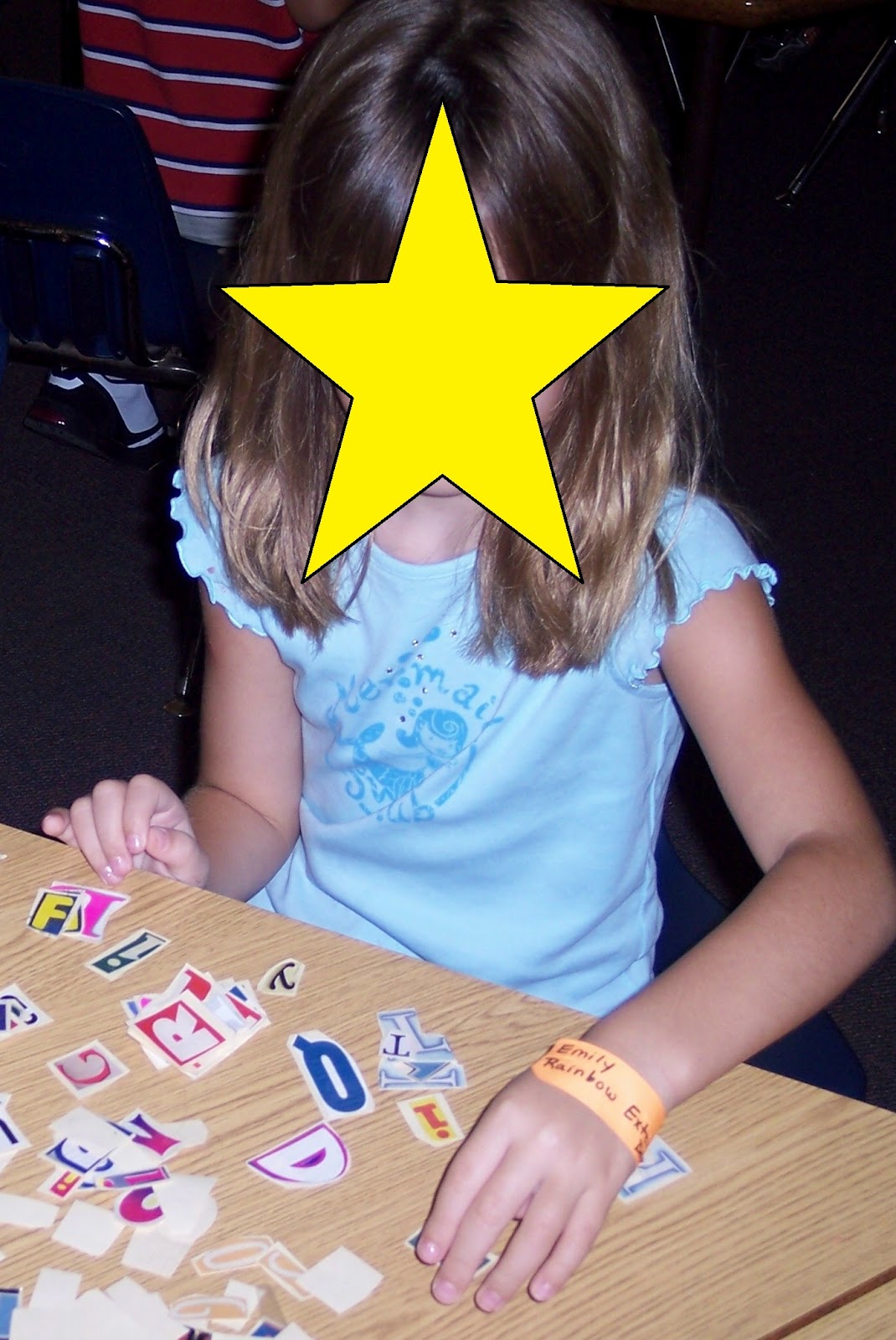
Kindergartners need a variety of ways to explore sight words. I try to vary it up. I have used playdough, letter stamps, and letter manipulatives (letter unifix cubes and letter beads). I even spent one summer cutting out letters from magazines, glued them on cardstock, and had them laminated! I was a bit crazy! Even though it was over 10 years ago, I still use them for letter manipulatives.


 Last year, some of my kinderkids made their names out of blocks and we took pictures.


This year, I want to have my students use blocks to make letters or sight words. I think it would be neat for them to also take pictures and keep them in a book. On TPT, I want to use these Snap cubes. I will have my students start making letters out of snap cubes first, then make words. I think some of my boys (& girls) will have fun with this!

2. Memorize high frequency words ( How often do you introduce new words? Do your students have their own list of words that they can work on? How will you keep track of words that they already know). I add 3-5 words per week, introducing them using the 4 Blocks Model. We keep track of our words on the word wall. My kindergarten team and I send home a VHS case for sight words. We have 6 colored sets of words based on the DOLCH word list. When a child has mastered a list, he brings his case of words back, and gets tested. If mastered, he gets the next set of words. A star is put on his sheet that is the cover of the VHS case and I also keep track by highlighting the words known (kept in my literacy binder). Some of the kindergarten teachers use first grade words when they have completed the 6 sets of words. I prefer not to rely on sight words lists at that point. Instead I encourage reading, as that is how we pick up new vocabulary.

3. Generalize spelling patterns (brainstorm a list of ways you can do this).
Some word wall words have patterns- put star on them after learn about the pattern. Word wall family books. Music. Cooperative learning strategies- All-Write Robin. Below are my students working in small groups brainstorming a list of rhyming words. Basically, each child gets a turn to write a word for the rhyming family. The others may help by giving clues. They keep going around writing as many words as they can in a 2-3 minute time period.


We also make words and sort words by their rimes. My students know if they know how to spell one word, they can spell many words because they are familiar with the pattern.


We also make art projects to go with our rhyming families. This one is -at. In first grade, I had my students use magazines to find letters to make -at words. In kindergarten, I do the same activity, but differentiate for those who need it. Some students write beginning sounds to ___at to make their at words. My cat template is at school. I will go in next week. So I will update in a couple of weeks to include that activity here. For now, you can click the picture to get the ___at worksheet. Updated 8/19/12 with Cat template and at worksheet, click picture below to go to google docs.


4. Adding to our knowledge and curiosity of unique and interesting words. (What is the best way to do this?) Make a theme word sight word list on pocket chart. Sometimes I write the words beforehand and find clipart for those words. Sometimes, my students illustrate words. Other times, my students predict words for the unit. Then we add as we learn new ones.


In the new school year, I hope to include Kim Adsit's anchor chart for vocabulary.

Other things to think about: What materials do I already have? What materials would I like to get? How will I store them? Where will students work?
I feel I have a variety of material. I'm not sure what else I would like. Guess I'll have to see what everyone else plans to do with word work. I store my supplies in crates and small containers (baby wipes containers are great!). In previous years, my centers have assigned areas, but children can move around the room. Now, I want to try out 4 different areas with all Daily 5 stations in each area. Children will rotate each day through the stations. One of the games I used last year:
Learning with Mrs. Parker's Roll a Sight Word

One of the teachers at my school went ahead and made the game on colored paper to match our 6 sets of sight words. This was a great way to differentiate, as the students worked on the words they were on.

I'll be linking up with the Kindergarten Daily 5. Looking forward to seeing the Daily 5 ideas!


2

Daily 5: Read to Someone

Sharing Kindergarten is hosting the "Read to Someone" part. Mary has a great resouce for Reading to Someone!! Click below to go there.


1. Why should students be reading to someone? They can help each other in many ways. It happens naturally at centers. My students read our poetry and student of day charts together. They also act out songs or short stories. I have them read in partners after reading groups. Sometimes they choose to read to self, and then they begin to share what they notice in books. As long as they are reading, listening to reading, working with words, or writing, I feel that they are on task. 

Also, outside of our reading block, we meet with our big buddies once a week to read with them. This is a great experience for both groups.
2. How can your students EEKK? I have not emphasized this particular structure. I've had my students practice facing knee to knee. Sharing Kindergarten has a fabulous cute poster that I will implement with my kinders this year. I will use it as a way to read with a partner, but still accept other ways as well. I do like to change it up with different chairs and pillow pets, too.

3. How can your students read to someone and how can you need to model these ways with your students? Sometimes, I have my students read to someone, but it's not always human. My students have read to the class pet (I've had gerbils, hermit crabs, bunny, and fish). When we hatch eggs, they love to read to the little chicks. Now, it is not the same benefits of reading to someone human. However, it does motivate my children to get reading! Now for reading to humans, I will be using Mary's Read to Someone posters.
4. What is the one thing you have done with partner reading that ensures the success of your students? Since I don't follow Daily 5's exact prescription, I think my success with partner reading is using variety- different people, different settings (inside or outside), and different props (finger pointers or pillows).

In case you haven't heard, I'm having a giveaway!! Please check it out and join in on the fun!
1

Daily 5: Listen to Reading


1. How will you instill the importance (or urgency as the sisters call it) of “listening to reading” in your students and especially those who have had little “lap time” or reading done for them in their homes? To instill early learning habits at home, I use a baggie book check out system in my classroom. This usually starts the 2nd week of school. In the past, I had my students pick any book. Now, I have them all start at an easy level, until I figure out their level. Then, they may choose different books at their level. I send home reading tips approximately once every other week. My first reading tip is sent home in the ziplock bag with a popsicle stick that has an eye on it. Click below on the popsicle picture to see my Reading Together letter and tip at Google docs.
At school, it seems natural for students to be interested in listening to reading. As long as I have enough space and materials for each child, it works out well. My difficulty lies in teaching my students to use a tape player! Marsha, at Differentiated Kindergarten, has a wonderful visual for helping with that!

2. What devices or strategies are you going to use to conduct listen to reading? Will you use a community recording device with one cd and several earphones, individual CD players, taper recorder, ipod-type devices, or computers? I have several listening to reading areas. I have a tape player and 3 walkmen in a basket which is called the listening center. No earphones for the tape player. Just books on tape. I also have a CD player for songbooks or books on CD. I also use the computer for listening to reading. I use software programs, such as Instant Readers. We also use online programs, such as Starfall or Tumblebooks. At the beginning of the year, my students work on an abc starfall book that I created. Click below to visit my TPT store for a free download and directions for using Starfall's ABCs.

3. What expectation will you have for your students during “listen to reading” and how will you keep them on task and independent instead of needing your assistance when they can’t manage the devices? At the beginning of the school year, I model the listening center with the whole class.  We listen to a story together as I hold the book up for them to see. Then we talk about our reading response journals. I model the steps, and they follow along. We do this for the first 2 weeks, and I let them be. However, I have had more problems with using a tape player in more recent years. I guess they no longer use them at home!! So I really need to work on the mechanics!

In the past, at each of my centers, I use a clear plastic sleeve for holding my directions. That way, I can easily type my directions up and change them as needed. I usually doodle some picture clues when I go over the directions with my students. For example, on the second page, at the end of the computer center directions, it states you may need help. I discuss with my students how they can do that and draw some suggestions.

Google Doc Link:


4. Do you have enough “listening to reading” type materials? If not, what ideas do you have for securing these materials? Where will you store them? How will your students retrieve these items? Where will they be used (will there be a designated spot in your class for listening or reading or will it be their choice)?  I do have a nice collection of books. I have tried varied ways of storing them. I had them stored with my theme boxes, but am back to switching them into crates. I only keep a few out in a basket. I use ziplock bags to keep the books, tape, and reading responses. Yep, ziplocks are my favorite! There are designated spots for the CD and tape player. The walkman may be used around the room.

To get more listening center material, I have had parents and school staff members record themselves reading a book. It is played at the listening center. The children have fun trying to guess who it is. Then we have the mystery guest reader come in and read to the class. Sometimes I like to throw them off by inviting a PE teacher or principal. Look below for starting Mystery Reader in your class.

Google Docs Link:


5. The sisters do not really talk about this in their book, but how do you feel about listening response sheets? Will listening to reading be just for “listening” or will there be follow-up work required of your students? If there is a reading response sheet, what will they look like? I do like reading responses. My students have a reading response journal. This is where they keep track of books they listen to. If my students only listened, I think some do get restless. So having them work and respond in a journal allows them to collaborate with others and draw their ideas on paper.
6. I would be remiss to not add this so… how can this station be differentiated to meet the various learning profiles, interest, and/or readiness of your students? Since my students have a reading response journal, and the question is usually open ended, my students work at their own levels. Some may draw with only beginning sounds, while others write sentences. Usually at the beginning of the year, I have them glue a reading response into their journal. My students draw a picture and write what they can about it.

Phew! This is a long post!! In case you haven't heard... I am having a Giveaway!. Please check it out!

1

Daily 5 Chapter 4

I am so loving reading what everyone is doing or plan to do with Daily 5 in their classrooms!  Mrs. Miner's Kindergarten Monkey Business is hosting this week. Click below to check out all the great ideas and encouragement!


How do I start out with enough books??

When I first started teaching, I went to the library, thrift stores, and asked for book donations for my classroom. I used many of the Scholastic mini-books. Here are a few:


With our reading series, I usually have a teacher set to print out mini-books. I have quite a few of these mini book sets and love them. There are also many teacher websites and blogs that have mini-books. Cherry Carl has numerous free ones at her sites. I have joined and used Reading A to Z for leveled mini-books in the past. I highly recommend joining their free trial. You can download some of their free resources.

1) How far into the school year do you think kinders need to be to be able to begin the process of Read to Self? What is realistic? When do you plan to begin implementation?

From the first day of school, I teach my students how to read. I think this reading is instilled from the belief of "If you want it, then teach it." When I first started teaching, we had DEAR (Drop Everything and Read) for 30 minutes. With my 4 Blocks training, DEAR became my Self-Selected Reading time. During the past two years, with new administration at my school, we no longer have that 30 minute DEAR time. So, now I incorporate more into my 90 minute reading block.
Read to Self does not last long on the first day of kindergarten. I aim for 5 minutes, but watch my students to see if I need to make adjustments. I also do not open my entire classroom library up to my students. Before reading, I introduce my class library. We discuss the labels and baskets of where books belong. I start with rebus readers. We talk about using pictures to tell a story. I have my students sit in a circle with me during that first week of school to practice reading our books. Sitting in a circle allows me to model with my little ones, as well as seeing them. I usually try to finish up before I see too much restlessness. That way they are excited about it the next day. After reading, we discuss how to put the books away. On the second day, I follow the same procedure, but now add a couple more basket of books. I keep introducing baskets of books as long as they show responsibility. If not, we keep reviewing, until we get it. If you are familiar with 4 Blocks, during Self-Selected Reading there are group basket of books. I select around 25-35 books for each of my groups. I usually introduce these to my students at the end of the first week or beginning of the second week. These book baskets have varied reading levels and types. We also make lots of little mini books in class and that is what starts my students own book bags/boxes.

2) How will you make sure that each child views him/herself as a reader (whether they are reading words or not)?

Because all my students can use pictures to tell their own stories, whether it makes sense to me or not, they can read. I do introduce “eagle eyes” on that first day of school using my stuffed animal eagle. He reminds us to use the pictures. I have not had a blind child in my classroom. I wonder how someone would explain reading to a blind kindergartner?

I also discuss environmental print with my students. All of them can recognize something that is meaningful to them. They bring in words they can read, and I make it a big deal that they can recognize these big words. They are proud of themselves too and they learn from each other. They bring words from home and we make a song book using their environmental print words.

3) What are some ideas you have about "Launching Read to Self" in kindergarten? How will you go about it and what are some ways to make sure it is "kinder friendly"?

Definitely a day by day basis focusing on practice and predictability. Although it can be routine, I provide excitement and novelty by adding something new by sharing the different choices, books, or buddy reading. In addition, using anchor charts will help my kinderkids better understand and remember what we do during that time.

4) How will you/do you build the children's belief that this IS important? What can we do to encourage the ones who do not value it and create disruptions for others?

There seems to be "the one" who needs extra support and attention in this, so that is who I focus on with extra encouragement. He or she may need practice to read the pictures to me. He or she may need to find a place where they can focus.

5) How valuable is Checking In and Reviewing with kindergarteners? How often will you do it? When will you do it? What are some different ways to "check in"?

We review before starting and assess how well we thought we did afterwards. I do reward often that first month of school. I use a Filling buckets concept in my class, and my students earn stars to fill their bucket. For each set of ten stars, they earn a different prize. I wean off as my students become more independent.

6)What are some problems that can occur during this problem (either that you anticipate with your kinders OR that you have experienced)? How can we be proactive about these issues?

My kinderkids have had issues of focusing for more than 3 minutes with reading to self. I usually work with them to give them strategies to read the book, by encouraging and modeling reading the pictures. Then I back off, and reinforce right away as needed. Sometimes, I give a child a timer (3 minute sand timer) and it does help.
I introduce little by little each day, adjusting depending on my class needs. Some classes, I can introduce more, as they seem to already have independence. While other classes, I have to introduce more slowly, and review more, since they are less familiar with the choices. I do work on encouraging and telling them that they will get more choices.

When I read this book a couple years ago, I checked the Daily 5 website and they have a great video to show how they handle children who have difficulties with read to self. There is a great write up about it as well. I watched and read it again! Click below to go to the specific video:

http://www.thedailycafe.com/public/178.cfm

Have a wonderful July 4th!!

1
Back to Top